Many thermal inspection offers say the work follows international standards and stop there. Without a name, that sentence commits to nothing.
The document that governs thermographic inspection of solar plants has a name: IEC TS 62446-3. It is the technical specification for outdoor infrared thermography of photovoltaic modules and plants. This article sets out what it governs, what it does not, and how the SolarDetech platform applies it.
What the specification governs
IEC TS 62446-3 is not a product certificate. It is a method document, and it governs four things.
- The weather and irradiance conditions under which images are taken.
- The minimum number of pixels a cell must cover in the image.
- How the temperature difference is measured and what it is normalised to.
- How findings are classified and what the report contains.
Together the four make an inspection repeatable. If you can fly the same plant in March and in July and compare the two results, the specification is what makes that possible.
Conditions: measured on every flight, not assumed
A thermal image reads a temperature difference. If a panel is not sufficiently under load, a damaged cell and a healthy cell do not differ enough to see. The specification therefore sets a lower irradiance threshold and asks for wind and cloud cover to be recorded.
In practice, a flight is made on a clear day at no less than 600 W/m² irradiance. An image taken on a cloudy day or early in the morning does not show that a panel is healthy. It shows only that measurement was not possible at that moment. The two look alike, and the only thing that separates them is a recorded set of flight conditions.
On the SolarDetech platform, the irradiance, wind and cloud cover of the flight hours are checked against the IEC TS 62446-3 thresholds, and a condition outside its threshold is flagged openly. The irradiance and weather conditions of every flight are written into the report's own conditions section. A report without that section cannot later show that the measurement was valid.
Resolution: at least 5×5 pixels per cell
The specification asks that a single cell covers at least 5×5 pixels in the image. Below that, one hot cell blends into its neighbours and disappears.
The rule sets the flight altitude directly. At 30 m, the images meet it for the current module formats M10 and G12, which are common in plants built today. Older modules with 156 mm cells do not meet it at the same altitude; they have to be flown lower.
So a flight altitude on its own is not a compliance statement. Without the cell format of the plant, nobody can say whether the resolution rule is met. The question to ask is simple: on my module format, at your flight altitude, how many pixels fall on one cell?
Measurement: under load, from multiple images, normalised
The specification asks for the temperature difference to be measured under load and normalised to irradiance. A temperature value that is not normalised cannot be compared between two flights, because nobody can tell whether the difference came from the panel or from the weather.
There is also the single-frame problem. A panel that looks warm in one image may be showing a reflection, a passing shadow or an effect of the camera angle. If the same panel shows the same deviation in several images, the finding is real. A flag based on one frame should not enter a report.
On the SolarDetech platform, each panel is compared with its neighbours, the difference is normalised to irradiance, and a finding is verified only when it is measured consistently in more than one raw frame. The three verification rules are on the methodology page.
Classification and the report
The specification also sets the structure of the report. An inspection report is not the note of whoever found the anomaly. It is a record a third party can check. It contains:
- The conditions of the inspection, irradiance and weather included.
- The equipment used and the flight parameters.
- The class and priority of every finding.
- Where exactly the finding is on site.
- The measured temperature difference.
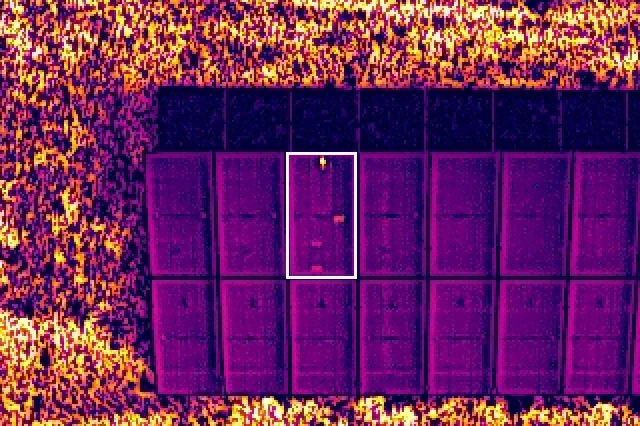
The last two are the ones most often left out. A count of hot spots on a site is a number, not a report. A field team can only use a finding whose row, table and panel are written next to it.
The 17 anomaly classes on the SolarDetech platform are SolarDetech's own classes, each with a priority of Very high, High, Medium or Low. The classification and the report structure follow the specification.
What the specification does not govern
Knowing the limits matters as much as knowing the rules.
- It is not a certification programme. Compliance means the work was flown, measured and reported according to the specification. It is not a certificate.
- It does not make one altitude right for every plant. The resolution rule depends on the cell format, as above.
- It does not replace electrical testing. A thermal and RGB inspection reads temperature and surface. I-V curve and insulation measurement are offered optionally through a solution partner, and inverter faults are followed through SCADA.
- It does not cover what happens after the report: work orders, panel history from flight to flight, production loss estimates and warranty claims. On the SolarDetech platform these run on the panel-level digital twin, described on the platform page.
What compliant means on the SolarDetech platform
Flown, measured and reported to IEC TS 62446-3 means four checkable things. The irradiance and weather conditions of every flight are recorded in the report's own conditions section. The resolution rule of at least 5×5 pixels per cell is met at 30 m for current module formats (M10, G12). Measurement is under load, from multiple images, and normalised to irradiance. Classification and the report structure follow the specification.
The flight standard behind it is published: 30 m altitude, RTK positioning, flight lines crossing the panel rows. Before processing, every orthomosaic passes an automatic acceptance check on coverage, row continuity, brightness uniformity and edge crispness.
Five questions to ask before an inspection
- Which specification do you work to, by name?
- Are the flight conditions written into the report?
- On my module format, how many pixels fall on one cell at your altitude?
- In how many images is each finding verified?
- Does the report give the exact location of every finding?
If all five answers can be had in writing, the document you receive is an inspection report. More answers, including own-drone requirements, are in the FAQ. To put your plant on the platform, send us your panel count and location. We reply within 24 hours with a quote. The platform itself is free; the inspection is priced by quote for your site.